Key Takeaways
- Resilience Training develops mental and emotional capacity to recover from setbacks, adapt to change, and maintain performance under pressure through structured learning and practice.
- Organizations are shifting from compliance-focused programs to continuous operational resilience that supports real-time decision-making during actual crisis situations.
- Side-of-desk exercises and cross-sector training are becoming mainstream methods for developing leadership resilience in 2026.
- Professional resilience training typically covers stress management, psychological safety, adaptive thinking, communication frameworks, and systems-level analysis.
- Certification pathways range from foundational awareness courses (8-16 hours) to advanced practitioner programs (40+ hours) with recognized CPD accreditation.
- Equity-centered approaches ensure resilience resources reach all organizational levels and community groups, not just senior leadership.
- Continuous readiness models are replacing one-time training events, emphasizing sustained capability development and measurable outcomes.
- Team resilience requires different competencies than individual resilience, including collective psychological safety and structured communication protocols.
- Practical application through scenario-based exercises and real-world simulations produces better outcomes than theoretical knowledge alone.
- Investment in resilience training correlates with improved employee retention, reduced burnout, faster crisis recovery, and stronger organizational culture.
Quick Answer
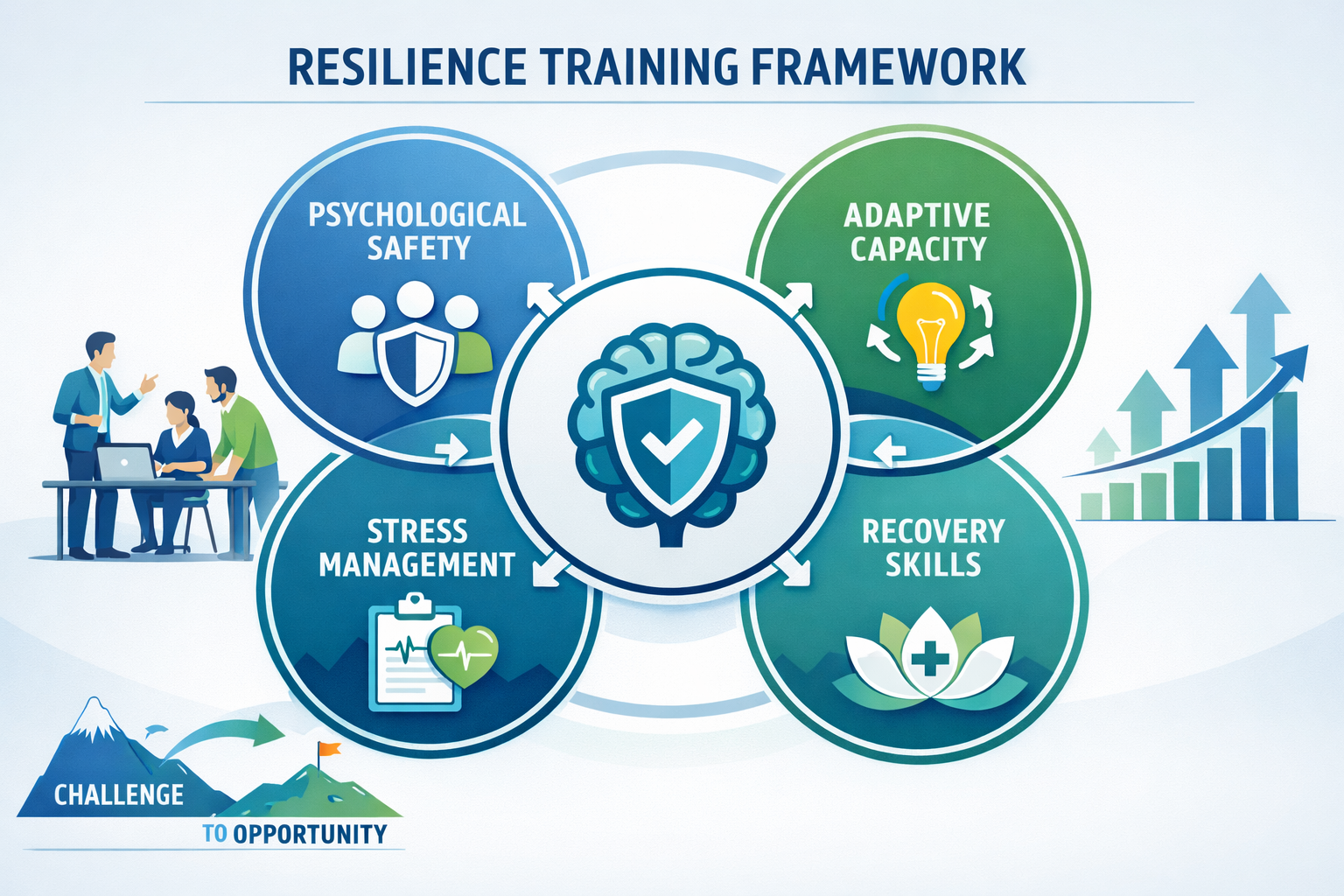
Resilience Training is a structured professional development approach that builds mental, emotional, and operational capacity to handle adversity, adapt to change, and maintain performance during challenging situations. It combines psychological principles, practical exercises, and systems thinking to develop both individual and organizational resilience. For working professionals, resilience training provides actionable frameworks for managing workplace stress, leading through uncertainty, and building adaptive capacity that translates directly into career advancement and organizational value.
What Is Resilience Training and Why Does It Matter?
Resilience Training is a systematic development process that strengthens the ability to withstand pressure, recover from setbacks, and adapt effectively to changing circumstances while maintaining wellbeing and performance. It teaches specific skills, mindsets, and behaviors that enable professionals to navigate workplace challenges, manage stress constructively, and emerge stronger from difficult experiences.
The training addresses both personal and organizational dimensions. At the individual level, it builds emotional regulation, adaptive thinking, stress management, and recovery skills. At the organizational level, it creates systems, protocols, and cultures that support sustained performance during disruption.
Why Resilience Training Has Become Essential in 2026
The professional landscape has fundamentally changed. Remote work transitions, technological disruption, economic uncertainty, and accelerated change cycles create constant pressure on working professionals. Traditional stress management approaches no longer suffice because they treat symptoms rather than building fundamental adaptive capacity.
Organizations are recognizing that resilience is not an innate trait but a developable skill set. According to recent industry analysis, operational resilience training is shifting beyond compliance into operational reality, with organizations moving from establishing baseline programs to maintaining resilience as an ongoing operational capability that supports real-time decision-making[2].
Key drivers for resilience training adoption include:
- Increased workplace complexity requiring adaptive problem-solving
- Higher rates of burnout and stress-related performance issues
- Need for leaders who can make decisions under pressure with imperfect information
- Recognition that crisis response capability requires practice, not just planning
- Competitive advantage from faster recovery and adaptation cycles
Who Benefits Most from Resilience Training
While resilience training benefits all professionals, certain roles and situations create particularly high value:
Choose resilience training if you:
- Lead teams through organizational change or uncertainty
- Work in high-pressure environments with tight deadlines and competing priorities
- Manage crisis response, business continuity, or operational risk
- Support others professionally (social workers, healthcare, education, support roles)
- Experience frequent setbacks or rejection in your role (sales, creative fields)
- Are transitioning careers or taking on expanded responsibilities
The training is equally valuable for individual contributors seeking personal development and organizational leaders building team capability. For those pursuing professional development and CPD training, resilience training offers recognized credentials that demonstrate adaptive leadership capacity.
What Does Professional Resilience Training Cover?
Professional Resilience Training programs typically include five core components that work together to build comprehensive adaptive capacity. Each component addresses specific skills while reinforcing the overall resilience framework.
1. Stress Recognition and Management
Participants learn to identify stress triggers, understand physiological and psychological stress responses, and apply evidence-based techniques for managing stress constructively. This includes breathing exercises, cognitive reframing, and recovery protocols that prevent chronic stress accumulation.
2. Adaptive Thinking and Mental Flexibility
Training develops cognitive flexibility through exercises that challenge fixed mindsets, build tolerance for ambiguity, and strengthen problem-solving under pressure. Participants practice reframing challenges as opportunities and identifying multiple solution pathways when initial approaches fail.
3. Emotional Regulation and Psychological Safety
Programs teach emotional awareness, regulation techniques, and how to create psychologically safe environments where team members can express concerns, admit mistakes, and ask for help without fear of judgment. This foundation enables honest communication during high-pressure situations[6].
4. Communication Frameworks for Crisis Situations
Structured communication protocols help professionals maintain clarity during chaos. Training covers briefing structures, decision-making frameworks, stakeholder management, and how to communicate effectively when information is incomplete or rapidly changing.
5. Systems Thinking and Interconnected Resilience
Advanced programs incorporate systems-level analysis tools that help practitioners identify leverage points, examine feedback loops, and understand how resilience in one area affects other interconnected systems[1]. This prevents solutions that solve one problem while creating others.
Practical Application Methods
The most effective resilience training emphasizes experiential learning over theoretical knowledge. Common methods include:
- Scenario-based exercises that simulate real workplace challenges
- Side-of-desk training that runs parallel to daily operations, requiring participants to balance routine responsibilities while responding to evolving incidents[2]
- Cross-sector exercises that test crisis arrangements alongside peers, regulators, and stakeholders[2]
- Reflective practice sessions that extract learning from actual experiences
- Peer learning groups that provide ongoing support and accountability
Common mistake: Treating resilience training as a one-time event rather than an ongoing development process. Resilience capability degrades without practice and reinforcement.
How Does Resilience Training Work in Practice?
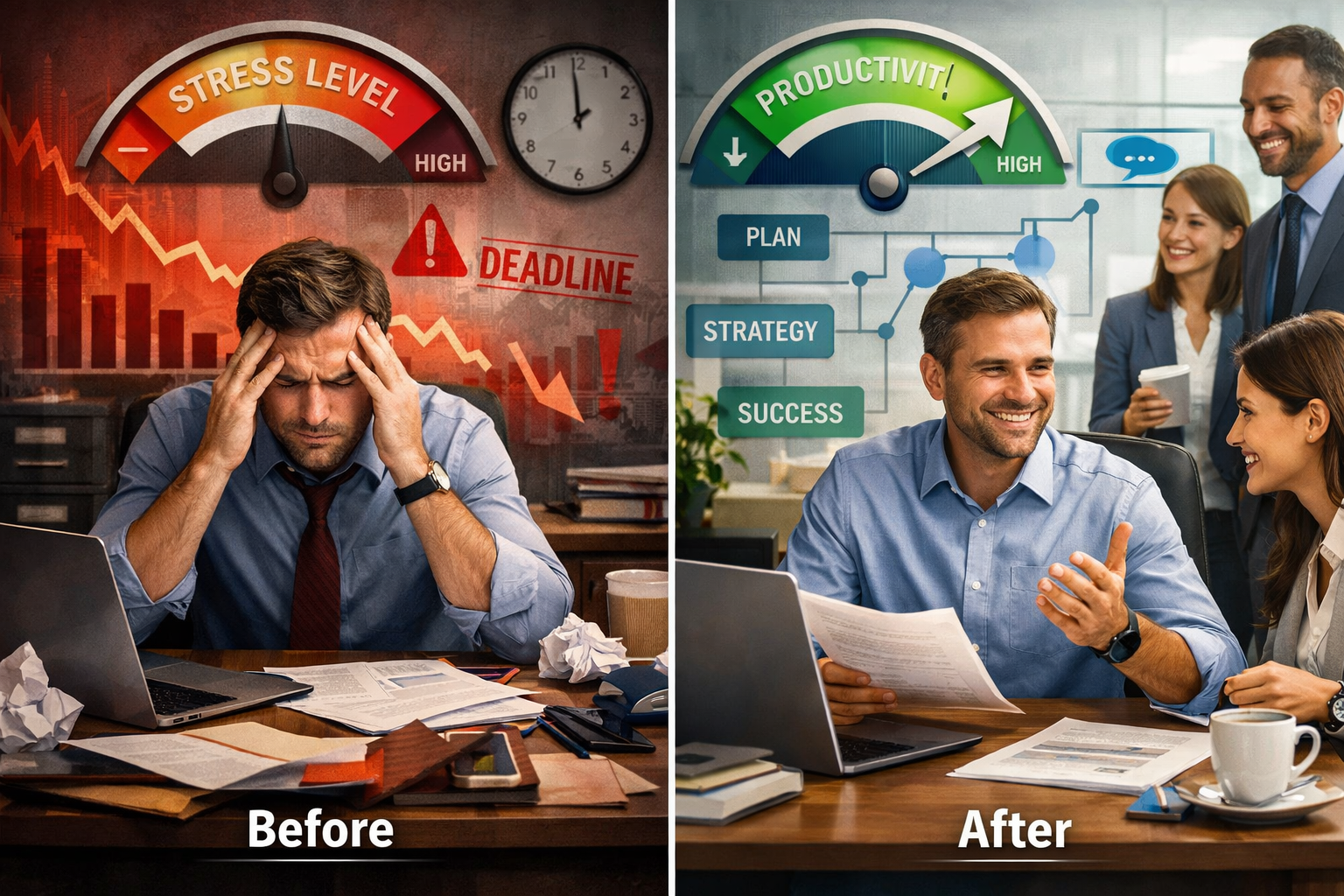
Resilience Training translates into workplace performance through structured application of learned skills during actual challenges. The training creates mental models and practiced responses that become automatic under pressure.
The Learning-to-Application Pathway
Step 1: Foundation Building (Weeks 1-2)
Participants establish baseline understanding of resilience concepts, complete self-assessment tools like the Personal Adaptability Inventory (PAI™) to identify current strengths and development areas[4], and learn core stress management techniques.
Step 2: Skill Development (Weeks 3-6)
Focused practice on specific competencies through guided exercises, case studies, and simulations. Participants practice adaptive thinking, emotional regulation, and communication frameworks in progressively challenging scenarios.
Step 3: Real-World Application (Weeks 7-10)
Participants apply learned skills to actual workplace challenges while receiving coaching support. This phase includes reflection exercises that reinforce learning and identify areas for continued development.
Step 4: Integration and Sustainment (Ongoing)
Resilience becomes embedded in daily practice through regular micro-exercises, peer support networks, and periodic refresher sessions. Organizations increasingly adopt continuous readiness models rather than one-time training events[7].
Side-of-Desk Exercises: The 2026 Standard
Side-of-desk exercising has become mainstream for leadership development in 2026. This high-engagement training model runs parallel to daily operations, requiring senior leaders to balance routine responsibilities while responding to evolving incidents, making time-critical decisions with imperfect information, and holding regular briefings[2].
Why this method works:
- Creates realistic pressure that classroom training cannot replicate
- Reveals actual decision-making patterns under stress
- Builds confidence through successful navigation of challenging scenarios
- Identifies capability gaps that theoretical training misses
- Increases leadership buy-in through direct experience of value
Team Resilience vs. Individual Resilience
Building resilient teams requires different approaches than developing individual resilience. Team resilience training focuses on collective capabilities including shared psychological safety, coordinated communication protocols, distributed decision-making authority, and mutual support systems[6].
Team resilience indicators:
- Members feel safe admitting mistakes and asking for help
- Communication remains clear and constructive under pressure
- Decision-making authority is appropriately distributed
- Team maintains performance when individual members are absent
- Collective learning happens after challenging situations
What Are the Different Types of Resilience Training Programs?
Resilience Training programs vary by focus area, delivery method, duration, and certification level. Understanding these distinctions helps professionals select training that matches their specific needs and career objectives.
By Focus Area
Personal Resilience Training
Concentrates on individual mental and emotional capacity. Suitable for professionals seeking personal development, stress management skills, or foundational resilience understanding. Typically 8-16 hours of instruction.
Leadership Resilience Training
Designed for managers and executives who must make decisions under pressure while supporting team wellbeing. Includes scenario-based exercises, crisis communication frameworks, and stakeholder management. Usually 16-24 hours with ongoing practice components.
Organizational Resilience Training
Systems-level approach covering business continuity, operational risk, crisis management, and organizational culture. Targets resilience professionals, risk managers, and senior leaders. Often 24-40+ hours with certification pathways.
Community Resilience Training
Focuses on building resilience capacity across communities and organizations through partnerships, resource development, and equity-centered approaches[5]. Common in public sector, non-profit, and community development roles.
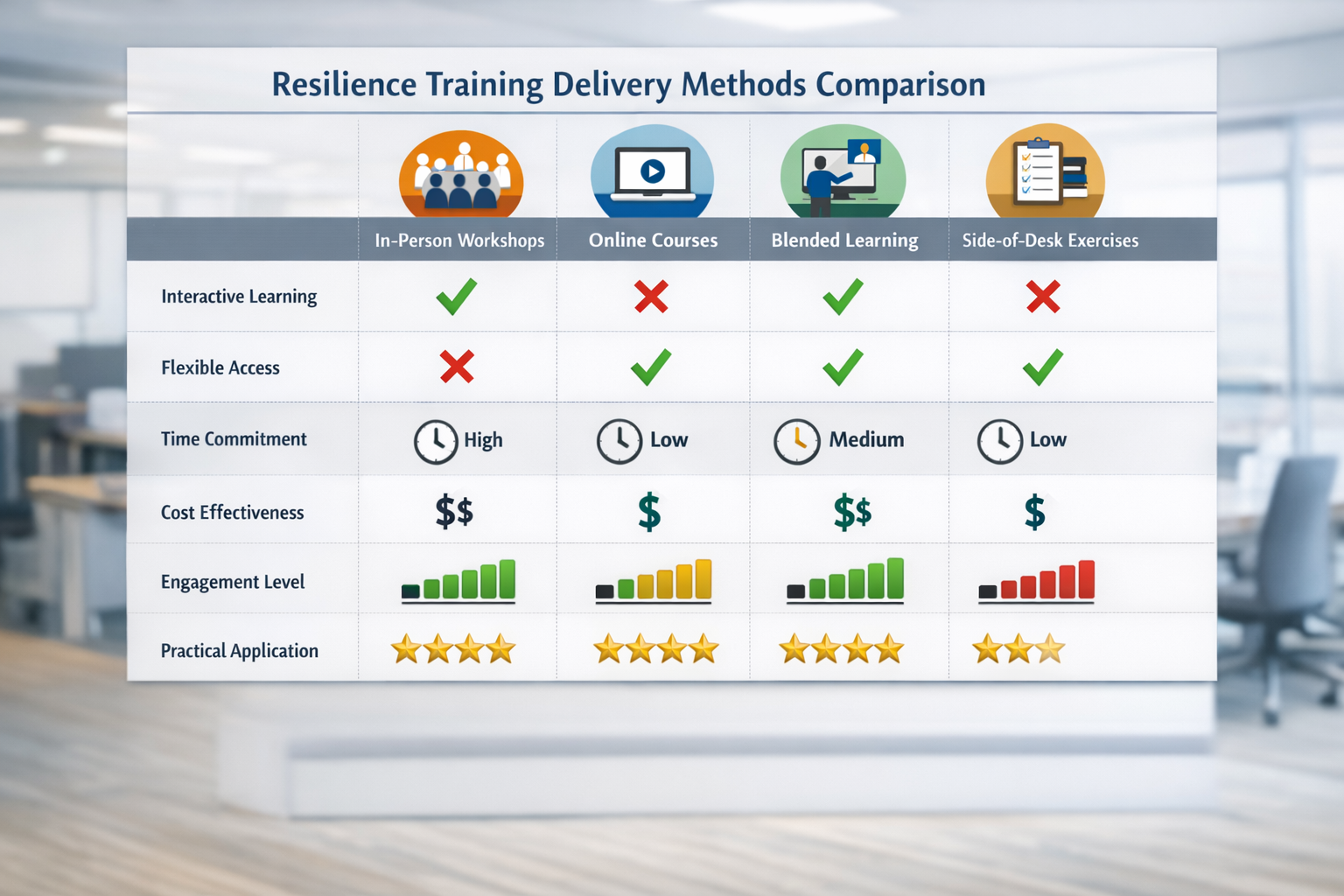
By Delivery Method
| Delivery Method | Best For | Typical Duration | Engagement Level | Cost Range |
| In-person workshops | Hands-on practice, team building | 1-3 days intensive | Very High | £££ |
| Online courses | Flexible scheduling, self-paced learning | 8-20 hours over 4-12 weeks | Medium | £ |
| Blended learning | Balance of flexibility and interaction | 12-24 hours over 8-16 weeks | High | ££ |
| Side-of-desk exercises | Leadership development, realistic scenarios | Ongoing over 3-6 months | Very High | £££ |
| Webinar series | Broad topic coverage, expert access | 12-24 sessions over 12 months | Medium | ££ |
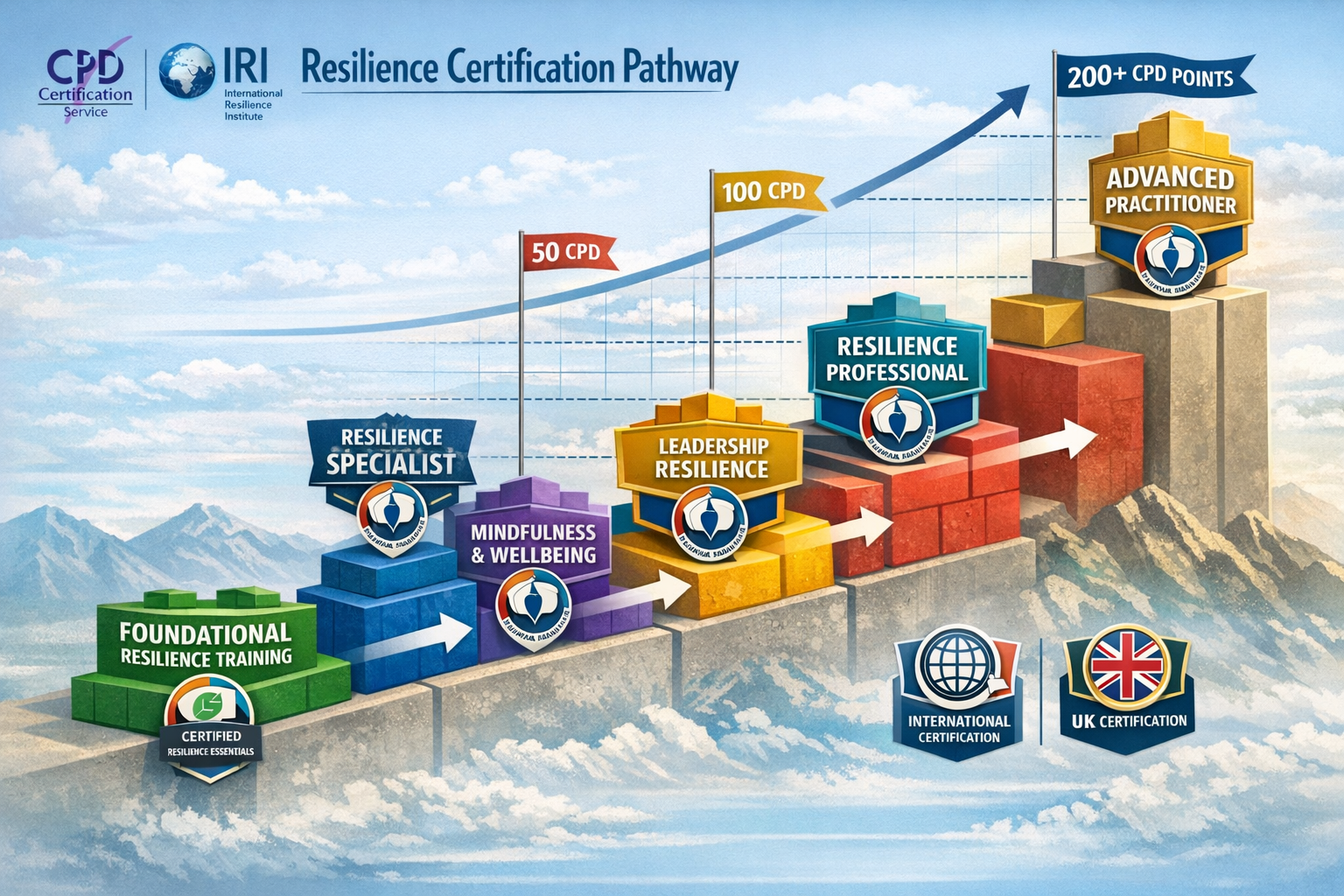
Certification Levels and CPD Recognition
Professional resilience training programs increasingly offer recognized certification that contributes to continuing professional development (CPD) requirements. For professionals seeking CPD training and points, resilience certifications provide valuable credentials.
Foundation Level (8-16 CPD hours)
Covers core resilience concepts, stress management basics, and personal adaptive capacity. No prerequisites. Suitable for all professionals seeking foundational knowledge.
Practitioner Level (24-40 CPD hours)
Comprehensive training in resilience frameworks, team resilience building, and practical application methods. May require foundation completion or equivalent experience. Targets managers, team leaders, and resilience champions.
Advanced Practitioner Level (40+ CPD hours)
Systems-level resilience, organizational culture change, program design, and resilience assessment methodologies. Requires practitioner certification or substantial professional experience. For resilience professionals, consultants, and senior leaders.
Specialist Certifications
Focus on specific domains such as cyber resilience, crisis communication, business continuity, or community resilience. Duration and requirements vary by specialization.
How Do You Choose the Right Resilience Training Program?
Selecting effective resilience training requires evaluating program quality, alignment with your development goals, practical application opportunities, and recognition value. Not all programs deliver equal outcomes.
Quality Indicators to Assess
Evidence-based content: Programs should reference psychological research, validated assessment tools, and proven frameworks rather than generic motivational content. Look for references to specific methodologies like the Personal Adaptability Inventory (PAI™)[4] or systems thinking tools[1].
Practical application focus: The best programs emphasize experiential learning through scenarios, exercises, and real-world application rather than purely theoretical instruction. Ask what percentage of time involves active practice versus passive listening.
Qualified instructors: Trainers should have both professional credentials in psychology, organizational development, or related fields AND practical experience applying resilience in professional settings. Academic knowledge without practical experience produces less relevant training.
Ongoing support: Resilience develops over time, not in a single session. Quality programs include post-training resources, peer networks, refresher sessions, or coaching support to sustain development.
Measurable outcomes: Programs should include assessment tools that measure baseline resilience and track development over time, providing concrete evidence of capability improvement.
Matching Training to Your Career Stage
Early career professionals: Focus on foundational personal resilience training that builds stress management skills, adaptive thinking, and emotional regulation. Online courses or short workshops (8-16 hours) provide good starting points without major time or financial investment.
Mid-career professionals and team leaders: Invest in practitioner-level programs that cover team resilience, leadership under pressure, and communication frameworks. Blended learning or intensive workshops (24-40 hours) offer the depth needed for leadership roles.
Senior leaders and resilience professionals: Advanced programs covering organizational resilience, systems thinking, and culture change deliver the strategic perspective needed at executive levels. Consider specialist certifications in your industry sector.
Career changers: If transitioning into roles requiring resilience skills (such as support worker positions or social work), prioritize programs offering recognized certification that demonstrates capability to potential employers.
Questions to Ask Before Enrolling
- What specific skills will I be able to demonstrate after completing this program?
- How much of the training involves active practice versus passive learning?
- What assessment tools measure my development?
- Is the certification recognized by professional bodies in my field?
- What post-training support is included?
- Can I speak with past participants about their experience?
- How does the program address both individual and team resilience?
- What is the instructor-to-participant ratio for interactive sessions?
Edge case: If your organization is paying for training, verify that the program aligns with organizational resilience priorities and that you'll have opportunities to apply learned skills in your role. Training without application opportunity produces minimal lasting value.
What Are the Current Trends Shaping Resilience Training in 2026?
Resilience Training continues to evolve rapidly as organizations learn what actually builds capability versus what simply checks compliance boxes. Several significant trends are reshaping how professionals develop resilience in 2026.
From Compliance to Continuous Operational Capability
Organizations are moving beyond establishing baseline resilience programs to maintaining resilience as an ongoing operational capability. This shift emphasizes continuous readiness rather than periodic training events, with regular micro-exercises, scenario testing, and capability assessments integrated into normal operations[2][7].
What this means for professionals: Expect resilience development to become part of regular work rhythms rather than isolated training events. Side-of-desk exercises and ongoing scenario practice are replacing annual workshops.
Whole-of-Society and Cross-Sector Exercises
Organizations increasingly test crisis arrangements alongside peers, regulators, and government stakeholders through large-scale, cross-sector exercises. These validate assumptions and stress-test coordination mechanisms in environments that reflect real-world complexity[2].
The Virginia Resiliency Academy exemplifies this approach with its 12-month program running March through December 2026, providing expert-led training on systems-level resilience for local government staff, regional partners, and community organizations[1].
Cultural Engagement as a Resilience Maturity Factor
As resilience responsibilities extend across organizations, success increasingly depends on influence, facilitation, and behavioral change rather than technical expertise alone. Many resilience teams are seeking targeted support to design engagement models and embed resilience thinking into everyday business decisions[2].
Practical implication: Resilience professionals need strong communication, change management, and stakeholder engagement skills alongside technical knowledge. Training programs increasingly incorporate these "soft skills" as core competencies.
Equity-Centered Resilience Frameworks
Multiple programs now emphasize justice-centered strategies and examination of how systemic inequities shape access to resilience resources. This ensures marginalized communities and lower-level employees are not excluded from resilience planning and development opportunities[1].
Training programs incorporating equity perspectives help participants recognize how resilience resources are distributed, identify barriers to access, and design interventions that reach those who need them most.
Resource-Based Resilience Approaches
Rather than focusing solely on individual psychological traits, resource-based approaches emphasize building tangible resilience assets including emergency readiness supplies, organizational partnerships, training classes, personal relationships, and participation in community activities that support health and wellbeing[5].
This practical orientation makes resilience more accessible by providing concrete actions anyone can take, regardless of their starting point or psychological characteristics.
Specialized Resilience Training for Specific Sectors
Industry-specific resilience training is expanding rapidly. Cyber resilience training for technology professionals, crisis communication training for public-facing roles, and operational resilience for regulated industries each require specialized knowledge beyond general resilience frameworks.
Choose specialized training if:
- Your industry faces unique resilience challenges (healthcare, finance, technology)
- Regulatory requirements mandate specific resilience capabilities
- Your role requires sector-specific crisis response knowledge
- General resilience training hasn't addressed your practical needs
How Can Organizations Implement Effective Resilience Training?
Organizational resilience training succeeds when it moves beyond individual skill development to create systemic capability that persists regardless of staff turnover. Implementation requires strategic planning, leadership commitment, and integration with existing development programs.
Building a Resilience Training Strategy
Step 1: Assess Current Resilience Capability
Conduct baseline assessment using validated tools to understand current individual, team, and organizational resilience levels. Identify specific capability gaps that training should address.
Step 2: Define Clear Objectives
Specify what resilience capabilities the organization needs based on actual risks, operational requirements, and strategic priorities. Avoid generic "build resilience" goals in favor of specific outcomes like "senior leaders can make time-critical decisions with 40% information" or "teams maintain 80% productivity during disruption."
Step 3: Select Appropriate Training Methods
Match delivery methods to learning objectives and organizational culture. Combine foundational online learning for broad awareness with intensive scenario-based exercises for critical roles. Consider side-of-desk exercises for leadership development[2].
Step 4: Create Application Opportunities
Ensure participants can immediately apply learned skills in their actual roles. This might include assigning resilience champions, creating peer support networks, or incorporating resilience practices into team meetings.
Step 5: Measure and Iterate
Track capability development through regular assessment, incident performance reviews, and participant feedback. Adjust training content and methods based on what actually builds capability versus what looks good on paper.
Common Implementation Mistakes
Treating resilience as an HR initiative rather than operational capability: Resilience training succeeds when operational leaders champion it and integrate it into business processes, not when it's isolated in HR development programs.
One-size-fits-all programs: Different roles require different resilience capabilities. Frontline staff need different skills than senior executives. Customize training to role-specific challenges.
No post-training reinforcement: Resilience capability degrades without practice. Build ongoing micro-exercises, refresher sessions, and peer support into the program design.
Ignoring organizational culture factors: Training individuals to be resilient while maintaining a culture that punishes failure, discourages help-seeking, or overworks staff produces minimal lasting benefit. Address systemic issues alongside individual development.
What Skills and Competencies Does Resilience Training Develop?
Resilience Training builds specific, measurable capabilities that translate directly into improved professional performance. Understanding these competencies helps professionals articulate the value of resilience training and apply learned skills strategically.
Core Individual Competencies
Emotional Regulation
The ability to recognize, understand, and manage emotional responses, particularly under pressure. This includes techniques for preventing emotional hijacking during stressful situations and recovering emotional equilibrium quickly after setbacks.
Cognitive Flexibility
Capacity to shift thinking patterns, consider multiple perspectives, and adapt problem-solving approaches when initial strategies fail. Includes tolerance for ambiguity and comfort with incomplete information.
Stress Management
Practical skills for managing physiological and psychological stress responses, including breathing techniques, cognitive reframing, physical recovery practices, and boundary setting that prevents chronic stress accumulation.
Growth Mindset
Viewing challenges as development opportunities rather than threats, learning from failure, and maintaining confidence in the ability to develop new capabilities through effort and practice.
Self-Awareness
Understanding personal stress triggers, typical response patterns, strengths and limitations, and how personal behavior affects others during challenging situations.
Team and Leadership Competencies
Psychological Safety Creation
Building environments where team members feel safe admitting mistakes, asking questions, expressing concerns, and challenging ideas without fear of embarrassment or punishment[6].
Crisis Communication
Maintaining clear, honest, timely communication during uncertain situations. Includes briefing structures, stakeholder management, and communicating decisions made with incomplete information.
Distributed Decision-Making
Appropriately delegating decision authority, empowering team members to act within defined parameters, and creating decision frameworks that maintain coordination without bottlenecking at leadership level.
Adaptive Leadership
Adjusting leadership style to match situation requirements, balancing directive action with collaborative problem-solving, and maintaining team morale during extended challenges.
Systems Thinking
Understanding interconnections between different organizational elements, identifying leverage points for intervention, and anticipating how changes in one area affect other systems[1].
Organizational Competencies
Scenario Planning and Testing
Designing realistic scenarios that test organizational capabilities, conducting exercises that reveal gaps, and extracting actionable learning from exercise outcomes.
Change Management
Leading organizational adaptation, managing resistance, communicating change rationale, and maintaining performance during transition periods.
Cultural Influence
Embedding resilience thinking into organizational norms, decision processes, and daily practices rather than treating it as a separate initiative.
Resource Development
Building resilience resources including partnerships, training programs, emergency preparedness systems, and community connections that support sustained capability[5].
These competencies are particularly valuable for professionals in roles requiring effective communication skills and adaptive capacity under pressure.
Frequently Asked Questions About Resilience Training
How long does resilience training take to show results?
Basic stress management techniques can produce noticeable benefits within days of practice. Fundamental resilience skills typically develop over 8-12 weeks of consistent application. Deep resilience capability that functions automatically under extreme pressure requires 6-12 months of practice and reinforcement. Organizational resilience culture change usually takes 12-24 months.
Can resilience really be trained or is it an innate trait?
Research consistently demonstrates that resilience is a developable skill set, not a fixed personality trait. While some individuals may have natural advantages in certain areas, everyone can significantly improve their resilience capacity through structured training and practice. The key is consistent application of learned techniques rather than one-time exposure to concepts.
How much does professional resilience training cost?
Costs vary widely based on delivery method, duration, and certification level. Self-paced online courses range from £50-£300. Instructor-led online programs typically cost £300-£800. In-person workshops run £500-£2,000 depending on length and provider. Advanced certification programs can exceed £3,000. Many employers cover costs for job-relevant training.
Is resilience training suitable for all industries?
Yes, though application contexts differ. Healthcare, emergency services, finance, technology, education, and social services face particularly high-pressure environments where resilience training delivers clear value. However, any professional dealing with deadlines, setbacks, change, or interpersonal challenges benefits from improved resilience capacity.
What's the difference between resilience training and stress management?
Stress management focuses on reducing or coping with stress. Resilience training builds fundamental adaptive capacity that includes stress management but extends to recovery from setbacks, adaptation to change, growth through challenges, and maintaining performance during extended difficult periods. Resilience is the broader capability; stress management is one component.
Do I need certification or is informal training sufficient?
This depends on your objectives. For personal development, informal training or self-study may suffice. For career advancement, professional credibility, or roles requiring demonstrated resilience capability, recognized certification provides valuable credentials. Organizations increasingly prefer certified resilience practitioners when hiring for relevant positions.
How does resilience training integrate with other professional development?
Resilience training complements most other professional development areas. It enhances leadership training by adding adaptive capacity, supports project management through improved stress handling, strengthens customer service skills through emotional regulation, and underpins career transitions by building change tolerance. Many professionals combine resilience training with CPD training in their field.
Can resilience training help prevent burnout?
Yes, when properly applied. Resilience training teaches recognition of early burnout signs, stress management techniques that prevent accumulation, boundary-setting skills, and recovery practices that restore capacity. However, training alone cannot compensate for systemic organizational issues like chronic understaffing or toxic culture that create burnout conditions.
What's the best way to practice resilience skills?
The most effective practice involves applying learned techniques to real workplace challenges rather than only practicing in training environments. Side-of-desk exercises that run parallel to daily work provide realistic practice opportunities[2]. Regular micro-exercises (5-10 minutes daily), reflection on challenging situations, and peer discussion groups also reinforce learning.
How do I know if a resilience training program is evidence-based?
Look for references to specific psychological research, validated assessment tools like the Personal Adaptability Inventory (PAI™)[4], and clear explanations of the theoretical frameworks underlying the training. Ask instructors about their qualifications and what research supports their methods. Be cautious of programs making unrealistic promises or relying solely on motivational content without practical skill development.
Is online resilience training as effective as in-person?
Both can be effective when well-designed, but they excel in different areas. Online training offers flexibility, accessibility, and opportunities for self-paced learning. In-person training provides hands-on practice, immediate feedback, team building, and higher engagement. Blended approaches combining online foundational learning with in-person scenario practice often produce the best outcomes.
What happens after completing resilience training?
Effective programs include post-training support such as peer networks, refresher sessions, coaching access, or ongoing micro-exercises. The most important factor is consistent application of learned skills in real situations. Many professionals join resilience communities of practice or seek advanced certifications to continue development.
Conclusion
Resilience Training has evolved from a niche professional development topic into a fundamental career capability for 2026 and beyond. The ability to adapt to change, recover from setbacks, manage stress constructively, and maintain performance under pressure directly impacts career advancement, job satisfaction, and organizational value.
The shift from compliance-focused programs to continuous operational capability means resilience is no longer something you learn once and check off a list. It requires ongoing practice, regular scenario testing, and integration into daily work patterns. Side-of-desk exercises, cross-sector collaboration, and equity-centered approaches are reshaping how professionals develop resilience capacity.
For working professionals seeking to build resilience capability, the path forward involves several clear steps:
Start with assessment. Use validated tools to understand your current resilience strengths and development areas. This provides a baseline for measuring progress and identifies where to focus initial effort.
Choose training that matches your needs. Consider your career stage, role requirements, learning preferences, and development objectives when selecting programs. Prioritize evidence-based content, practical application opportunities, and recognized certification if credentials matter for your career path.
Commit to consistent practice. Resilience capability develops through regular application of learned skills to real challenges, not through passive knowledge acquisition. Plan how you'll practice new techniques in your actual work environment.
Build support systems. Connect with peers who are also developing resilience capacity. Share experiences, discuss challenges, and maintain accountability for continued practice.
Integrate with broader development. Resilience training complements other professional development areas including leadership, communication, project management, and technical skills. Consider how resilience capability enhances your overall professional profile.
The investment in resilience training pays dividends throughout your career. Professionals with strong resilience capacity navigate change more successfully, recover from setbacks faster, maintain wellbeing under pressure, and demonstrate the adaptive leadership that organizations increasingly value.
Whether you're seeking foundational personal resilience skills, leadership capabilities for managing teams through uncertainty, or advanced organizational resilience expertise, structured training provides the frameworks, techniques, and practice opportunities that build lasting capability.
The question is not whether resilience matters for professional success—the evidence is clear that it does. The question is whether you'll develop this capability proactively through structured training or reactively through trial and error during actual crises. Resilience training offers the opportunity to build strength before you need it, creating a foundation that supports your entire career.
References
[1] 2026 Resiliency Academy Exploring What Resilience Looks Like - https://resilientvirginia.org/initiatives/2026-resiliency-academy-exploring-what-resilience-looks-like/
[2] Six Resilience Trends For 2026 - https://www.4cstrategies.com/news/six-resilience-trends-for-2026/
[4] Rebuild Your Resilience Be The Best You Can Be In 2026 - https://blog.changefirst.com/rebuild-your-resilience-be-the-best-you-can-be-in-2026
[5] How To Increase Your Resilience In 2026 - https://www.bainbridgeprepares.org/news/how-to-increase-your-resilience-in-2026
[6] How To Build Resilient Teams In 2026 - https://inukacoaching.com/change-management/how-to-build-resilient-teams-in-2026/
[7] From Check Box Training To Continuous Readiness How One Immersive Customer Is Preparing For 2026 - https://www.immersive.com/resources/blog/from-check-box-training-to-continuous-readiness-how-one-immersive-customer-is-preparing-for-2026