Search

Level 3 Economics Certificate
Level 3 Economics Certificate Hero Imgs
£419.00 25
Save Over 70% - Offer Ends soon
Take this course ⟲ 14-Day Money-Back Guarantee
  • Lifetime Access
  • All Levels
  • PDF Certificate certificate_fill
GET ACCESS TO ALL 1200+ COURSES FOR ONLY £49 . Get Now

Learn with Confidence

IOAS High Quality Assurance
AoHT Member
CPD QE Member
International Quality Scheme
CPD Accredited Provider
Disability Confident Committed
Incensu Registered
14 Days Money Back Guarantee
Lifetime Access
SSL Secure
CPD Accredited Provider

Overview

Level 3 Economics Certificate

The Level 3 Economics Certificate is an economics course designed to build an understanding of core economic ideas and how they shape markets and economic activity. Learners explore the basics of economics, how economists use models and graphs, and the relationship between the economy and economics. The course also examines capitalism, decisions about what to produce and market, inflation, central banks and monetary policy. It provides a structured introduction for anyone who wants to study economics and develop a stronger foundation for further learning or economics-related work. The curriculum progresses from fundamental concepts towards economic systems and policies with confidence.

  • Basics of Economics
  • Economic Models and Graphs
  • Capitalism and Production Decisions
  • The Economy and Economics
  • Inflation, Central Banks and Monetary Policy

Course Overview

The Level 3 Economics Certificate provides knowledge for learners interested in economics, business, finance, banking, markets and economic policy. This economics course explores how economic thinking helps explain decisions about production and markets, while introducing models, graphs, capitalism, inflation, central banks and monetary policy. These subjects are relevant to people considering economics-related roles in business, financial services, research, public-sector organisations and policy environments. Learners can use the knowledge developed through the course to better understand economic conditions, market decisions and monetary issues in workplace discussions or further study. The course may be particularly useful for beginners seeking an accessible introduction before progressing to more advanced economic courses. It can also support existing learners or professionals who want economic awareness, although specialist careers such as economist normally require additional education and relevant training. The course offers useful subject foundations for learning and professional development.

Description

This economics course follows a progression from fundamental economic concepts to economic systems and policy. Learners begin with the basics of economics before exploring how economists use models and graphs to represent and understand economic ideas. The curriculum then considers the relationship between the economy and economics, the principles of capitalism, and decisions about what to produce and market. The final substantive module introduces inflation, central banks and monetary policy, helping learners connect economic theory with real-world policy topics. An assignment provides an opportunity to consolidate learning across the course. These modules create a foundation for learners to continue learning.

Course Curriculum

Module 1: Basics of Economics

This module introduces the fundamental ideas underpinning economics and establishes the foundation for understanding the subject.

Main learning topics:

  • Basics of economics
  • Fundamental economic concepts
  • Core economic ideas
  • Introduction to economic thinking

Module 2: Understanding How Economists Use Models and Graphs

This module explores how economists use models and graphs to represent economic ideas and make economic concepts easier to understand.

Main learning topics:

  • Economic models
  • Economic graphs
  • How economists use models
  • How economists use graphs
  • Representing economic ideas

Module 3: The Economy and Economics

This module examines the relationship between the economy and the study of economics, helping learners understand the subject within a wider economic context.

Main learning topics:

  • The economy
  • Economics
  • Economic activity
  • Relationship between the economy and economics

Module 4: Capitalism

This module introduces capitalism as an important economic system and develops learners’ understanding of its role within economics.

Main learning topics:

  • Capitalism
  • Economic systems
  • Capitalist economy
  • Principles of capitalism

Module 5: Deciding What to Produce and Market

This module examines economic decisions surrounding what should be produced and taken to market, linking economic thinking with production and market decisions.

Main learning topics:

  • What to produce
  • Production decisions
  • Market decisions
  • Producing and marketing goods or services
  • Economic decision-making

Module 6: Inflation, Central Banks and Monetary Policy

This module introduces three important areas of economic policy: inflation, central banks and monetary policy, helping learners understand their relationship within the economy.

Main learning topics:

  • Inflation
  • Central banks
  • Monetary policy
  • Economic policy
  • Relationship between inflation and monetary policy

Module 7: Assignment

The assignment provides an opportunity for learners to consolidate and apply their understanding of the topics covered throughout the course.

Main learning topics:

  • Course learning consolidation
  • Application of economic knowledge
  • Review of key economic concepts
  • Assignment work

Who Is This Course For?

This course is suitable for beginners who want to study economics and develop a structured understanding of core economic concepts. It may be useful for learners interested in business, banking, finance, markets, economic research and public-sector or policy-related environments.

It can also support career changers who want to explore whether economics-related work is suitable for them before progressing to more advanced economic courses. Existing professionals working around business, finance or economic decision-making may find the subject knowledge useful for developing broader economic awareness.

Learners interested in becoming economists should recognise that professional economist roles normally require additional education and relevant training. The National Careers Service states that a degree in economics or a related subject is typically required for this career.

Requirements

No formal entry requirements have been provided for the Level 3 Economics Certificate. Therefore, learners should not assume that specific GCSEs, A levels, previous economics qualifications, professional experience or registration are required.

A general interest in economics and a willingness to engage with economic concepts, models, graphs, markets and policy topics may be helpful, but these are learning recommendations rather than stated formal entry requirements.

Skills You Can Develop

Economic understanding — Develop a clearer understanding of fundamental economic concepts and the relationship between economics and the economy.

Economic model and graph interpretation — Build familiarity with how economists use models and graphs to represent economic ideas.

Economic decision-making awareness — Develop an understanding of decisions concerning what to produce and market.

Economic systems knowledge — Develop knowledge of capitalism and its place within economic thinking.

Economic policy awareness — Build understanding of inflation, central banks and monetary policy.

Market awareness — Improve your understanding of the economic considerations connected with production and markets.

Analytical economic thinking — Develop a structured approach to understanding economic concepts, relationships and policy topics.

Learning Outcomes

By the end of the course, learners should be able to:

  1. Understand the fundamental concepts covered by the basics of economics.
  2. Explain the relationship between the economy and economics.
  3. Identify how economists use models to represent economic ideas.
  4. Recognise how graphs are used within economic analysis.
  5. Describe capitalism as an economic system.
  6. Explain economic considerations involved in deciding what to produce and market.
  7. Identify the meaning and significance of inflation within the economy.
  8. Explain the role of central banks in the economic system.
  9. Describe the purpose and relevance of monetary policy.
  10. Apply knowledge from the course when reviewing and consolidating key economic concepts through the assignment.

Career Paths

Economist

Typical UK Salary: £28,000–£60,000 a year, according to the National Careers Service.

How the course is relevant: The course introduces economics, models and graphs, economic systems, production and market decisions, inflation, central banks and monetary policy. These areas provide useful foundational knowledge for learners exploring economics. However, economist roles typically require a degree in economics or a related subject, so this course should not be treated as a substitute for that professional pathway.

Economic Research or Analysis Roles

Typical UK Salary: Salary varies considerably by role, employer, experience and specialism. Current UK earnings data is published by the Office for National Statistics and can vary by occupation and region.

How the course is relevant: Understanding economic models, graphs, markets, production decisions and monetary policy can provide useful subject knowledge for learners exploring research or analysis-related work. Specific analyst roles may require additional qualifications, technical skills and experience.

Banking and Financial Services Roles

Typical UK Salary: Varies by occupation, employer, experience and location.

How the course is relevant: Knowledge of inflation, central banks, monetary policy, markets and economic decision-making can be relevant to learners interested in banking and financial services. Individual roles may require additional finance, economics, mathematical or professional training.

Business and Market-Focused Roles

Typical UK Salary: Varies according to role, sector, employer, experience and location.

How the course is relevant: The curriculum covers decisions about what to produce and market, capitalism and economic activity. This can provide useful economic context for people working in or exploring business and market-related environments.

Salary figures are indicative rather than guaranteed earnings. Actual pay depends on experience, location, employer, responsibilities and the specific role.

FAQs

What is the Level 3 Economics Certificate?

The Level 3 Economics Certificate is an economics course covering fundamental economic concepts, models and graphs, capitalism, production and market decisions, inflation, central banks and monetary policy.

What will I learn on this economics course?

You will study the basics of economics, how economists use models and graphs, the relationship between the economy and economics, capitalism, decisions about what to produce and market, inflation, central banks and monetary policy.

Is this economics course suitable for beginners?

Yes. The curriculum begins with the basics of economics and progresses towards economic systems, production and market decisions, inflation and monetary policy, making it suitable for learners seeking foundational knowledge.

What are the main modules in the course?

The main modules cover Basics of Economics; Economists’ Use of Models and Graphs; The Economy and Economics; Capitalism; Deciding What to Produce and Market; Inflation, Central Banks and Monetary Policy; and an Assignment.

Why should I study economics?

Studying economics can help you understand how economic systems, markets, production decisions, inflation and monetary policy relate to wider economic activity. This knowledge may also support further study in economics-related subjects.

What careers are related to an economics course?

Economics knowledge can be relevant to areas including economics, economic research, analysis, banking, financial services, business and market-related work. Specialist roles may require additional qualifications, training or experience.

Does this course qualify me to become an economist?

The course provides foundational economics knowledge but should not be treated as a standalone professional qualification for becoming an economist. The National Careers Service states that economist roles typically require a degree in economics or a related subject.

Course Content

Chapter 01 Basics of Economics

  • Basics of Economics
    00:00

Chapter 02 Understanding How Economists use Models and Graphs

Chapter 03 The Economy and Economics

Chapter 04 Capitalism

Chapter 05 Deciding what to Produce and Market

Chapter 06 Inflation, Central banks and Monetary policy

Assignment

Hear from Our Successful Learners

reviews.io
Harry Rose
Harry Rose
★★★★★

The experience has been excellent from the start to the present. The support team is proactive and always helpful with any queries or requests.

Archer Evans
Archer Evans
★★★★★

I've taken several courses through Reed and have been completely satisfied with each one. The pricing is outstanding.

Zane John
Zane John
★★★★☆

I've completed numerous courses through Reed and have been fully satisfied with each one. The courses are excellent.

Oliver Ross
Oliver Ross
★★★★★

I'm truly impressed by One Education's remarkable ability to understand its learners and go the extra mile for them.

Melvin Olson
Melvin Olson
★★★★★

I had been searching for a Level 3 course for a while—it felt like mission impossible. Discovering that Reed offers a wide range of career-focused providers was a pleasant surprise.

Lillie Marsh
Lillie Marsh
★★★★★

The course was incredibly insightful and easy to navigate. I truly enjoyed it—thank you so much.


Trustpilot
Sophie Turner
Sophie Turner

Booking was simple and the course content was clear and well structured from day one.

Daniel Hughes
Daniel Hughes

Great value for money and the certificate arrived quickly after I finished my assessment.

Priya Patel
Priya Patel

Customer support answered my questions the same day. Would definitely recommend to a friend.

James Whitfield
James Whitfield

Flexible learning that fit around my job. The video lessons were easy to follow.

Anna Kowalski
Anna Kowalski

Second course I've taken with them now. Consistent quality every time.

Marcus Reid
Marcus Reid

Clear instructions, fair pricing, and the exam prep really helped me pass first time.

Frequently Asked Questions

Once you enrol, you will receive access to your course online. You can log in and study at a time and place that suits you, using a computer, tablet or compatible mobile device.

You can study at your own pace, giving you the flexibility to complete your course around your existing work, family and other commitments.

Yes. Compete High courses are delivered online, allowing you to access your learning materials from wherever you are.

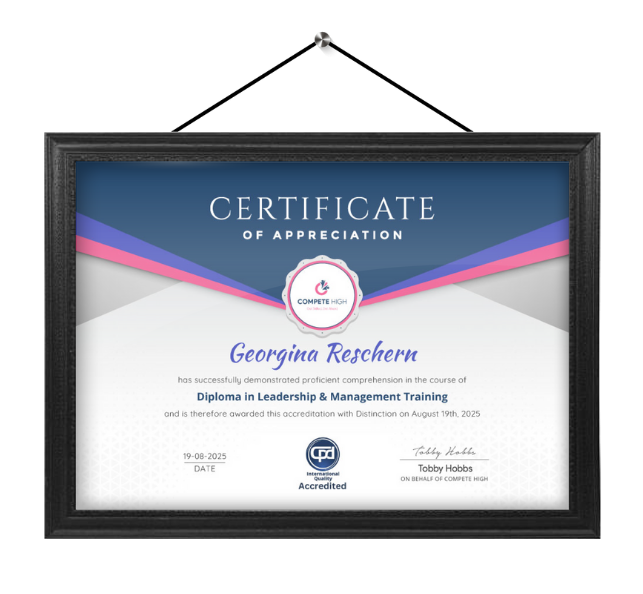
Where a certificate is included with the course, you will be able to obtain your certificate after successfully completing the required course requirements. Certificate availability can vary by course.

Course accreditation, certification and awarding arrangements vary depending on the individual course. Please check the course description for the specific details applicable to the course you are interested in.

Get Your Certificate Today

Team success

Celebrate your achievement with a CPD-IQ accredited certificate from Compete High! Perfect for showcasing your skills, boosting your career, and enhancing your professional profile. Choose the format that works best for you: PDF Certificate (£9.99) – Download instantly to add to your portfolio, résumé, LinkedIn, or share on social media. Printed Hard Copy (£29.99) – A beautifully designed certificate delivered to your door, ready to proudly display in your office or home. Both PDF & Printed Hard Copy (£31.99) – Get the best of both worlds!

Order Now