Level 3 Certificate in Improving Critical Thinking and IQ

- Lifetime Access
- All Levels
- PDF Certificate
Learn with Confidence









Overview
Level 3 Certificate in Improving Critical Thinking and IQ
The Level 3 Certificate in Improving Critical Thinking and IQ is designed to develop thinking, reasoning and information analysis skills. Learners explore how to approach problems logically, recognise cognitive biases, evaluate information and use creative techniques to generate ideas. The course covers critical thinking, problem-solving, logic, reasoning, heuristics, information literacy and analysis, providing a foundation for clearer and more deliberate thinking. It is suitable for learners who want to strengthen their approach to decisions, study, research or work. Rather than focusing on an IQ score alone, the course concentrates on thinking processes that can be developed through learning and practice.
- Critical Thinking and Problem-Solving
- Logic and Reasoning
- Cognitive Biases and Heuristics
- Information Literacy and Analysis
- Creative Thinking Techniques
Course Overview
The Level 3 Certificate in Improving Critical Thinking and IQ develops transferable thinking skills that can be useful across education, business, research, administration and other knowledge-based environments. Learners examine critical thinking and problem-solving before progressing into logic and reasoning, cognitive biases and heuristics, information literacy and analysis, and creative thinking techniques. These areas can help learners approach information carefully, question assumptions, recognise potential bias, structure reasoning and consider alternative solutions. The course may be relevant to people interested in research, market research, analysis, business support, project work or roles requiring careful evaluation of information. It can also support learners preparing for further study where analytical and reasoning abilities are useful in a range of settings. The course does not measure or guarantee an IQ score; instead, it focuses on learnable approaches to thinking and problem-solving. Specific professional roles may require additional qualifications, technical skills or workplace experience beyond this course.
Description
This course provides a structured introduction to critical thinking and reasoning skills. Learners begin with critical thinking and problem-solving, then explore logic and reasoning as tools for reaching clearer conclusions. The curriculum examines cognitive biases and heuristics, helping learners recognise influences that can affect judgement. Information literacy and analysis develop a more considered approach to evaluating information, while creative thinking techniques introduce methods for generating and exploring ideas. Together, the five modules provide a coherent progression from foundational thinking skills to information analysis and creativity. The course is relevant to learners seeking stronger analytical habits for study, work and decision-making.
Course Curriculum
Module 1: Introduction to Critical Thinking and Problem-Solving
This module introduces critical thinking and problem-solving as foundations for approaching questions, challenges and decisions in a more structured way.
Main learning topics: Critical thinking; problem-solving; structured thinking; approaches to problems.
Module 2: Logic and Reasoning
This module explores logic and reasoning, helping learners understand how structured reasoning can support clearer thinking and more considered conclusions.
Main learning topics: Logic; reasoning; logical thinking; structured conclusions.
Module 3: Cognitive Biases and Heuristics
This module examines cognitive biases and heuristics, introducing concepts that can influence how people interpret information, make judgements and approach decisions.
Main learning topics: Cognitive biases; heuristics; judgement; decision-making influences.
Module 4: Information Literacy and Analysis
This module focuses on information literacy and analysis, helping learners develop a more careful approach to understanding and evaluating information.
Main learning topics: Information literacy; information analysis; evaluation; interpretation; analytical thinking.
Module 5: Creative Thinking Techniques
This module introduces creative thinking techniques that can help learners generate, explore and develop ideas from different perspectives.
Main learning topics: Creative thinking; creative techniques; idea generation; exploring alternatives; developing ideas.
Who Is This Course For?
This course is suitable for learners who want to improve their critical thinking, reasoning, information analysis and creative thinking skills. It can be particularly relevant to beginners seeking a structured introduction to these areas without assuming specialist prior knowledge.
The course may also interest learners working in or exploring research-related environments, business support, administration, market research and analytical roles where information needs to be considered carefully. The National Careers Service identifies analytical thinking and logical reasoning among the skills relevant to market research data analyst work, making these areas a useful point of connection.
Students can also use the course as a foundation for further study where reasoning, information literacy and analysis are relevant. Existing professionals may find the subject useful for strengthening their approach to workplace decisions, information evaluation and problem-solving.
The course can also appeal to anyone searching for an answer to questions such as “what’s the average IQ in the UK?” or “average UK IQ 2026?” who wants to move beyond IQ statistics and focus on the thinking processes that can actually be studied and practised.
Requirements
No formal entry requirements have been supplied for the Level 3 Certificate in Improving Critical Thinking and IQ.
There is no stated requirement for GCSEs, A levels, a previous qualification, professional experience, professional registration or specialist technical knowledge. Learners should therefore not assume that any of these are mandatory entry requirements.
An interest in critical thinking, reasoning, problem-solving, information analysis and creative thinking may be helpful, but this is a recommendation rather than a formal course requirement.
Skills You Can Develop
Critical thinking — Develop a more structured approach to examining questions, ideas and problems.
Problem-solving — Build approaches for considering problems and working towards clearer solutions.
Logical reasoning — Strengthen your ability to use logic and structured reasoning when considering conclusions.
Bias recognition — Develop awareness of cognitive biases and heuristics that may influence judgement.
Information literacy — Develop a more informed approach to understanding and evaluating information.
Information analysis — Strengthen your ability to examine information carefully and consider what it means.
Creative thinking — Learn techniques for generating and exploring ideas from different perspectives.
Analytical thinking — Develop a more deliberate approach to interpreting information and considering alternatives.
Learning Outcomes
By completing the course, learners should be able to:
- Understand the fundamental principles of critical thinking and problem-solving.
- Identify approaches that can support structured problem-solving.
- Explain the role of logic in structured thinking.
- Apply reasoning principles when considering information and conclusions.
- Recognise common concepts associated with cognitive biases and heuristics.
- Explain how biases and heuristics can influence judgement and thinking.
- Use information literacy principles when considering information.
- Analyse information using the concepts covered in the course.
- Identify creative thinking techniques that can support idea generation.
- Develop a more deliberate approach to critical, analytical and creative thinking.
Career Paths
Market Researcher
Typical UK Salary: £24,000 starter to £28,000 experienced.
How the course is relevant: Market researchers gather and examine information about products, services and issues. Critical thinking, information literacy, analysis and reasoning can provide useful foundational skills for understanding research information. The National Careers Service lists analytical thinking and attention to detail among relevant skills for this role.
Market Research Executive
Typical UK Salary: £20,000 starter to £36,000 experienced.
How the course is relevant: Market research executives may undertake desk research, analyse information and present research findings. The course’s focus on logic, reasoning, information literacy and analysis can support foundational knowledge relevant to this type of work. The National Careers Service also identifies analytical thinking and attention to detail as relevant skills.
Market Research Data Analyst
Typical UK Salary: £24,000 starter to £50,000 experienced.
How the course is relevant: This role involves studying information and statistics collected through research. The course can provide useful foundations in analytical thinking, information analysis and logical reasoning. However, the role can require additional qualifications or specialist data-analysis skills, so this course should not be considered a standalone route into the profession.
Data Analyst-Statistician
Typical UK Salary: £28,000 starter to £65,000 experienced.
How the course is relevant: Critical thinking, logic, reasoning and information analysis are conceptually relevant to analytical work. However, professional data analyst-statistician roles typically involve substantial statistical or mathematical knowledge and may require a degree or other relevant qualifications, so further training would normally be needed.
Operational Researcher
Typical UK Salary: £26,000 starter to £60,000 experienced.
How the course is relevant: Operational researchers analyse problems and help organisations make decisions. The course’s emphasis on critical thinking, problem-solving, logic and reasoning can provide useful foundational knowledge, although specialist operational research careers normally require additional education, technical knowledge and experience.
Salary figures are indicative UK ranges rather than guaranteed earnings. The National Careers Service states that its salary information is intended as a guide and can vary according to employer, location, experience, working hours and other factors.
FAQs
What is the Level 3 Certificate in Improving Critical Thinking and IQ?
It is a course focused on developing critical thinking, problem-solving, logic, reasoning, awareness of cognitive biases, information literacy, analysis and creative thinking techniques. It focuses on thinking processes rather than promising a particular IQ score.
What will I learn on this course?
You will study critical thinking and problem-solving, logic and reasoning, cognitive biases and heuristics, information literacy and analysis, and creative thinking techniques.
Can this course improve my IQ?
The course is designed around thinking skills and processes rather than measuring or guaranteeing an increase in IQ. It develops areas such as reasoning, problem-solving, information analysis and creative thinking that can be strengthened through learning and practice.
What is the average IQ in the UK in 2026?
There is no single official UK national average IQ figure that should be treated as a definitive 2026 statistic. IQ results depend on the test used, the sample, standardisation method and population studied. This course does not attempt to establish the UK average IQ; instead, it focuses on learnable thinking skills.
Is the course suitable for beginners?
Yes. The curriculum begins with an introduction to critical thinking and problem-solving before progressing through logic and reasoning, cognitive biases and heuristics, information literacy and analysis, and creative thinking techniques.
Course Content
Module 1_ Introduction to Critical Thinking and Problem-Solving
-
Introduction to Critical Thinking and Problem-Solving
00:00
Module 2_ Logic and Reasoning
Module 3_ Cognitive Biases and Heuristics
Module 4_ Information Literacy and Analysis
Module 5_ Creative Thinking Techniques
Hear from Our Successful Learners


The experience has been excellent from the start to the present. The support team is proactive and always helpful with any queries or requests.

I've taken several courses through Reed and have been completely satisfied with each one. The pricing is outstanding.

I've completed numerous courses through Reed and have been fully satisfied with each one. The courses are excellent.

I'm truly impressed by One Education's remarkable ability to understand its learners and go the extra mile for them.

I had been searching for a Level 3 course for a while—it felt like mission impossible. Discovering that Reed offers a wide range of career-focused providers was a pleasant surprise.

The course was incredibly insightful and easy to navigate. I truly enjoyed it—thank you so much.


Booking was simple and the course content was clear and well structured from day one.

Great value for money and the certificate arrived quickly after I finished my assessment.

Customer support answered my questions the same day. Would definitely recommend to a friend.

Flexible learning that fit around my job. The video lessons were easy to follow.

Second course I've taken with them now. Consistent quality every time.

Clear instructions, fair pricing, and the exam prep really helped me pass first time.
Frequently Asked Questions
Get Your Certificate Today
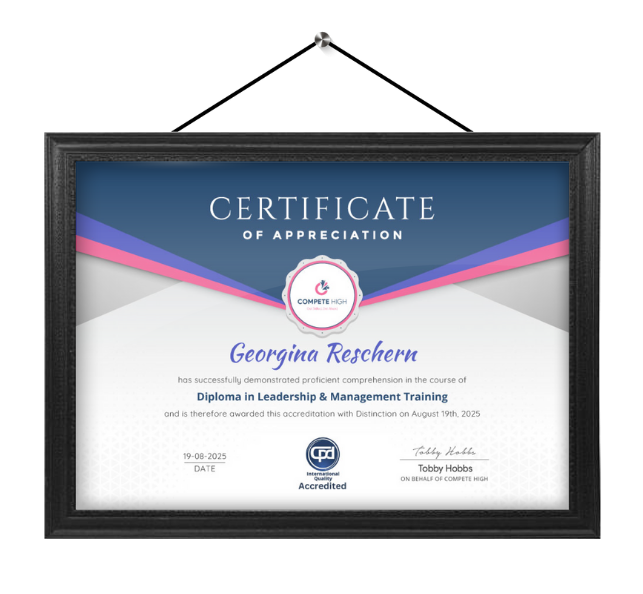
Celebrate your achievement with a CPD-IQ accredited certificate from Compete High! Perfect for showcasing your skills, boosting your career, and enhancing your professional profile. Choose the format that works best for you: PDF Certificate (£9.99) – Download instantly to add to your portfolio, résumé, LinkedIn, or share on social media. Printed Hard Copy (£29.99) – A beautifully designed certificate delivered to your door, ready to proudly display in your office or home. Both PDF & Printed Hard Copy (£31.99) – Get the best of both worlds!
Order Now